1. Sigma-algebra and Lebesgue measure
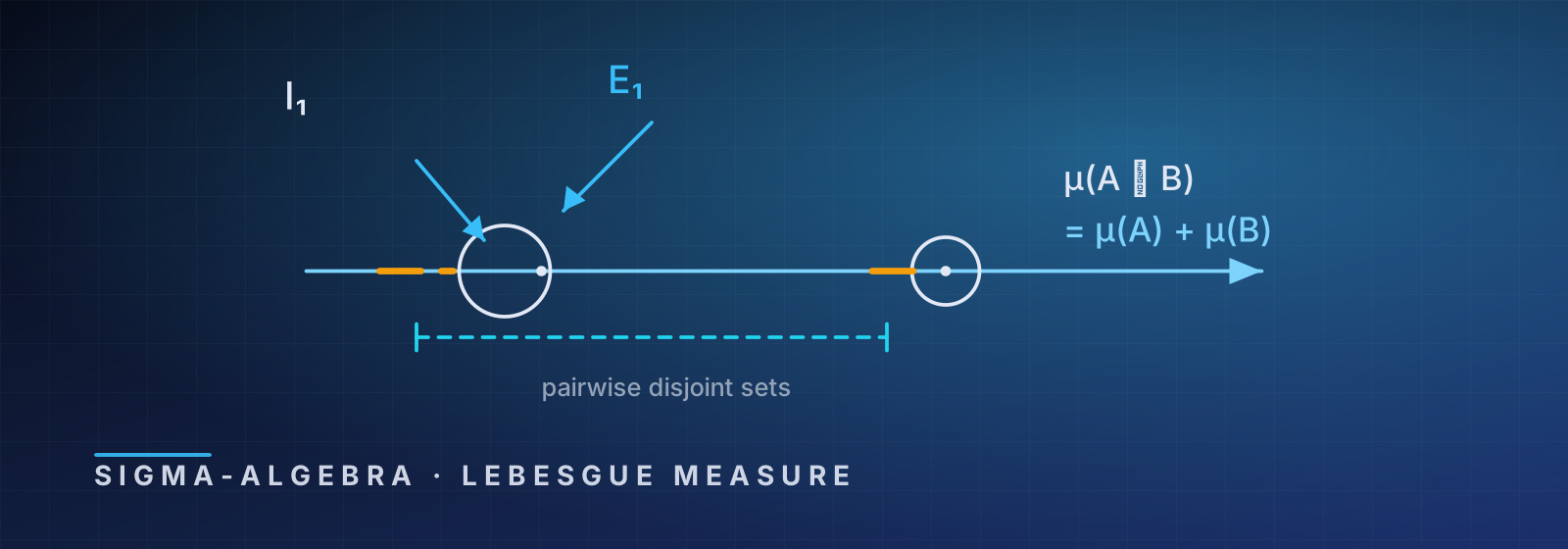
A sigma-algebra is the collection of sets a measure is allowed to touch, and the Lebesgue measure extends length to almost every subset of the real line. Use them as the foundation before measure-theoretic probability, integration and Monte-Carlo arguments.
- Reading time
- 5 min
- Length
- 853 words
- Updated
- Sep 15, 2026
- Total views
- --
1. Sigma-Algebra
For the source of definition, it's from wiki [1], as is given in Definition. 1.1, The sigma-algebra ==describe the property that a set is always self-closed==.
Sigma-algebra If
, then an example of -algebra on is , where is the empty set. In general, a finite algebra is always a σ-algebra if it :
- Including whole set
- Close for complementary set
- Close for and
, then
2. Lebesgue Measure
Lebesgue measure defines the, see [2] for details.
the Lebesgue measurable is the standard way of assigning a measure to subsets of higher dimensional Euclidean n-spaces.
(1) Length of the set
we describe the measure of Lebesgue measurable set
for
Lebesgue Outer Measure Lebesgue Outer Measure: For subset
, we define the Lebesgue outer measure as the minimum discontinuous summation :
We take
as a 2-element set, as a open set that contains each element of , then we set the length of is : Then the sum of length should be :
then the
, i.e., we have
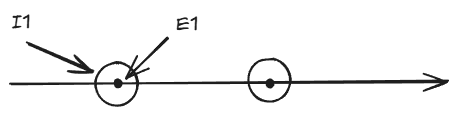
The equivalent statement of is, for any
For a rectangular cuboid
This gives, the set and be convered with limited ranged boxes. The classic example: a single point, then a finite set. Firstly, We Let
(three points on the real line). Intuitively, three isolated points have "zero length." The outer measure confirms this. For any ε > 0, cover each point with a tiny open interval:
- 0 ∈ (−ε/6, ε/6), length = ε/3
- 1 ∈ (1−ε/6, 1+ε/6), length = ε/3
- 2 ∈ (2−ε/6, 2+ε/6), length = ε/3
For a range set
, Lebesgue measure is :
(2) Useful properties
- Given any ==countable collection of sets== from an algebra (or σ‑algebra)
, we can replace it with a ==disjoint countable collection== of sets that are also in and have the same union.
For every
To prove this, we can take the
so any countable algebra can be represented as disjoint collections.
(3) Lebesgue measurable set
Caratheodory criterion : if a set
where
Borel
algebra We note Borel algebra is the smallest algebra containing all open sets.
The Lebesgue measure of such set
3. Axiom of Choice and Vitali Sets
Axiom of Choice This axiom states that : for every set
, and every -indexed family of non-empty sets, there exists an I-indexed set of elements of such that for every To be short, This axiom says you can get at 1 element from
each if its non-empty
Vitali Sets[3] is not Lebesgue measurable. A typical Vitali set is to choose exactly one representative from the each equivalence class under the following relation:
or set the Vitali set as
from wiki, we know that we can find uncountable pairwise-disjoint set such that :
If
This will create a contradiction that