3. Variational Lower Bound (VLB)
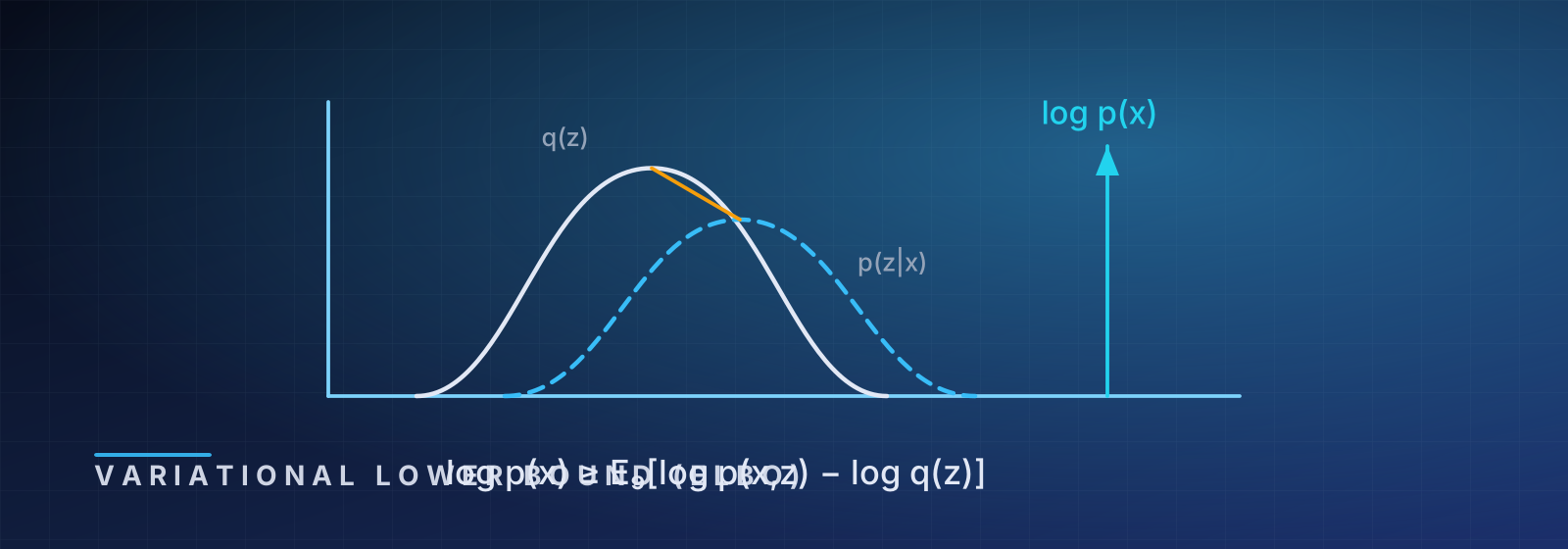
The variational lower bound (VLB), also called the evidence lower bound (ELBO), is a tractable lower bound on a latent-variable model's log evidence. Use it when exact posterior inference or marginal-likelihood evaluation is intractable.
- Reading time
- 2 min
- Length
- 421 words
- Updated
- Sep 15, 2026
- Total views
- --
1. Variational Lower Bound (VLB) / Evidence Lower Bound (ELBO)
VLB and ELBO are two names for the same objective in variational inference. “Variational lower bound” emphasizes that the bound is constructed with a variational distribution; “evidence lower bound” emphasizes that it lower-bounds the log evidence (log marginal likelihood). They should not be treated as distinct losses.
Note : for the concept of the posterior probability, see[1]
(1) Setup
Let
Bayes’ rule gives the exact posterior
Here,
The problem is about the posterior
, and the variance lower bound is a lower bound estimation of posterior :
(2) Derivation of the common objective
Start from the KL divergence[2:1] between the approximate and exact posteriors :
Rearranging gives :
Since
The shared VLB/ELBO objective is therefore :
This form (1.2.4) can still be referenced from wiki[3]. The bound is tight exactly when the variational posterior equals the exact posterior:
(3) Equivalent likelihood–regularization form
Using
Maximizing this single objective simultaneously (1) improves how well the model explains the observed data and (2) makes the variational posterior remain close to the chosen prior. Equivalently, optimization may minimize
2. When to use it
Use the VLB/ELBO when:
- a model contains latent variables and requires an approximate posterior
; - direct evaluation or differentiation of
is intractable; - the variational family and its gradient estimator are tractable enough to optimize.
The term evidence means the marginal likelihood
, not a separate model component. Thus the difference between the names is terminological, not mathematical.