Knowledge base
🧑🔬Mechanics
Notes filed under 🧑🔬Mechanics.
Subfolders
1 folderNotes in this folder
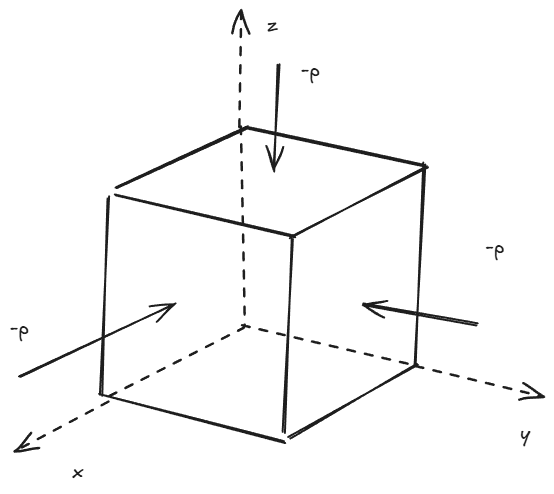
🧑🔬Mechanics / 🧊 Basics of Finite Element Method
2. Strong and Weak Form of Linear Elasticity Equivalence
The weak (variational) form follows from the strong equilibrium equations by testing with virtual displacements and integrating by parts. Use it as the blueprint of a finite-element implementation: it fixes the trial and test spaces, the bilinear form and the Neumann terms.
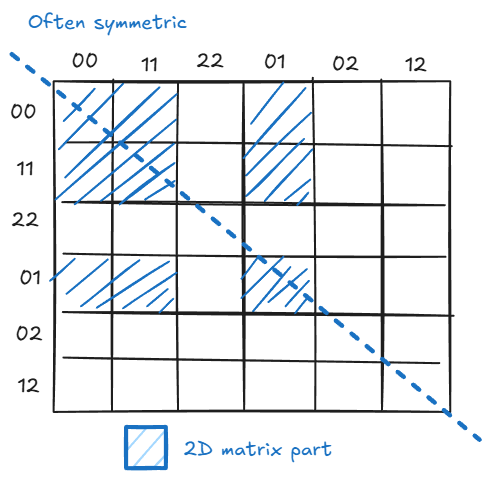
🧑🔬Mechanics / 🧊 Basics of Finite Element Method
1. Symmetric Stiffness Tensor and Voigt notation
Voigt notation packs symmetric stress and strain tensors into six-component vectors, so the elasticity tensor becomes a symmetric 6x6 matrix. Use it to read, write and implement constitutive laws compactly, including their FEniCSx form.
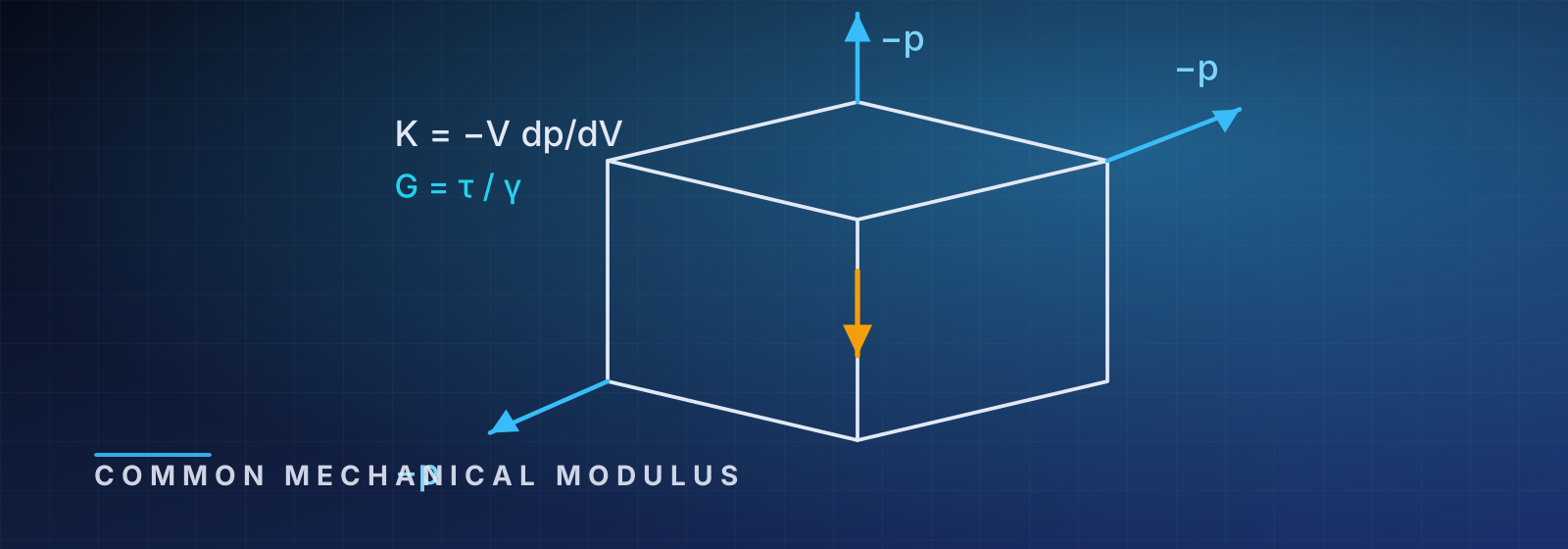
🧑🔬Mechanics / 🧊 Basics of Finite Element Method
3. Definition of Common Mechanical Modulus
Bulk modulus, shear modulus, Young's modulus and Poisson's ratio are the handful of constants that connect stress and strain in linear elasticity. Use this page to define and convert between them when feeding material data into a simulation.