1. Summary for basics of probability theory-Prior and Posterior Probability
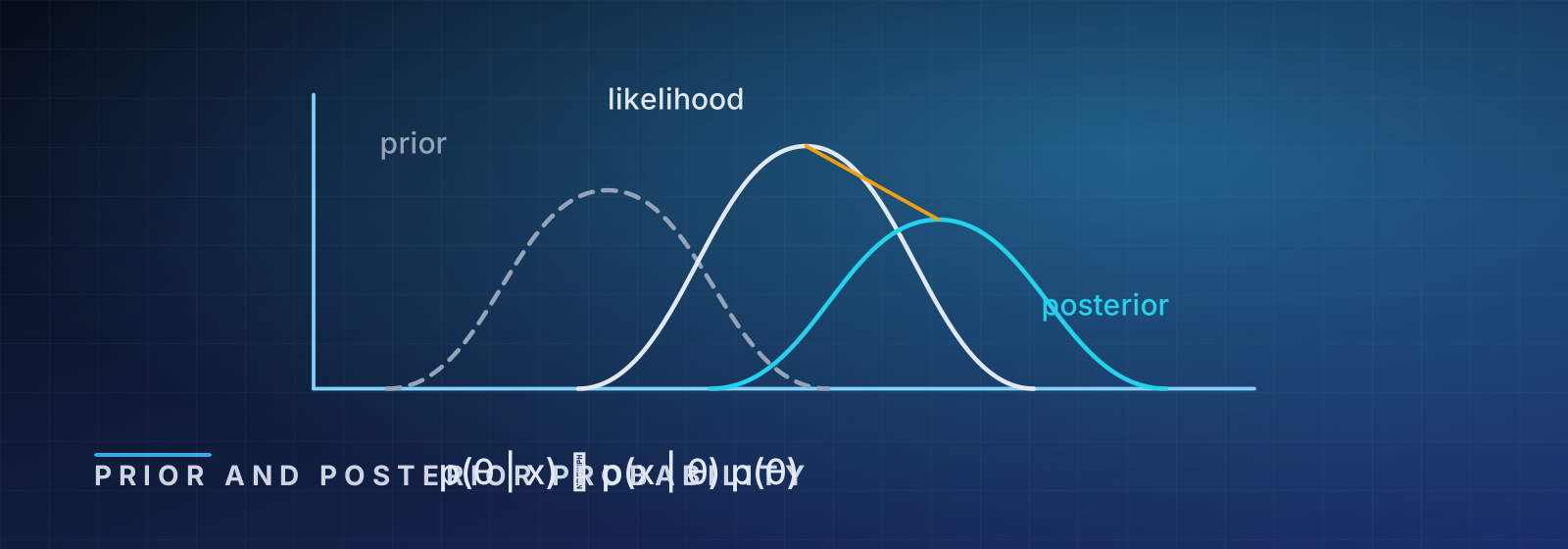
Prior, likelihood and posterior describe how a belief about a hidden parameter is updated by observed data. Use this summary as the reference for Bayes rule before moving on to sampling, Markov chains and variational inference.
- Reading time
- 2 min
- Length
- 382 words
- Updated
- Sep 15, 2026
- Total views
- --
(1) Basic Concepts
Gaussian Distribution function :
Take we generate a random number
Posterior probability: If we know the result
Prior probability : the probability to reach a result
Integration computation of the mean and variance :
We also have following preferred computational formula :
(2) Bayes Formula
From [1], we know the basic form of bayes formula is :
Then we got the relation between Prior and Posterior Probability :
This is the formula for the calculation of posterior probability, Where
(3) Similarity Estimation for Parameters
1. ML (maximum likelihood/maximum prior)
Maximum likelihood estimation is to maximize
This is also maximum prior estimation.
2. MAP (maximum posterior)
If the prior probability is given, we can use
In that case, since the
from this comes often-used formula :
(4) Bayes Inference
refer to [3], Bayes estimation is for estimating the probability that new data appears.
Assume that we have the observed data
(5) Normalizing Constant
For example, we have :
then we have
so the Normalizing Constant (or Normalizing factor) for function (5.1) is