1. Trust Region Policy Optimization (TRPO)
TRPO improves a policy monotonically by maximizing a surrogate advantage inside a trust region measured with KL divergence. Use it when policy-gradient updates must stay stable, and as the reference that later methods such as PPO simplify.
- Reading time
- 13 min
- Length
- 2,371 words
- Updated
- Sep 15, 2026
- Total views
- --
1. Introductions & Preliminaries
What is so-called reinforced learning
The reinforced learning is a computational approaches by emphasizing on the learning by an agent from direct interaction with its environment
(1) Concepts of TRPO
1. Concepts of random state functions
The trust region policy optimization (TRPO)[1] is a gradient-based method optimization algorithm, the variants of TRPO includes the vine method and the single-path method.
- single-path method can be applied in the model-free-settings
- vine method requires the system to be restored to particular states.
- Firstly, we define the following Markov decision process[2] :
We note except the concepts in original statement, the
The reinforced learning process is a kind of
2. Random state functions
Firstly, we define the following 3 random state functions for optimization :
Random state functions
- Definition of state-action-value function
, defined as the average reward on all available current state and action :
fixes both the state and the action , representing the result when take specific action . And is the foresight. This describes the recent reward when we take action at time .
- The no-policy value function
, we note here the input action of this step is not defined, so : In this function, the action
is not given, drawn from the policy
- The advantage function
is : where the
is current-step action, and is the next state, and this is affected by the current state and action , for every
We note in above theorem, the
Also note the definition of the above random-state function in [3] is different, which is :
state-action value :
The difference is that the (1.1.2~3) is normalized by following factor :
3. Average Notations under specific policy
For a policy with
where
In the second term in equation , the
We note we also use following notation :
(2) Expected discounted reward
Here the
The initial state is given by:
(3) Policy Relation Theorem
Then, the expected return of another policy
Policy relation
Such expectation is taken over the trajectory
To derive Lemma. region-policy-relation,.We know from (3.1.1)[2:4] that, for a fixed policy
Then
We also note here that the optimal policy gives :
Substituting (1.3.2) into (advantage-function), we use the
For a specific time
Then, we prove from (policy-relation), here :
So using (1.2.1), we have :
Since starting from
the expected return under policy is
(4) Visitation Frequencies
We let the
This is the sum of the possibility to visit a specific state over some time. This is positive on every term. The
Using the relation (policy-relation), we can expand it using (1.1.5), we also limit the result state and action, i.e.,
Since the state on any
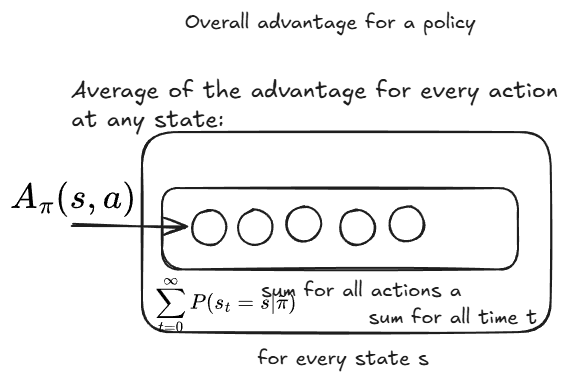
Title To help to understand above equations,
We note that A policyis a rule or probability distribution for selecting actions, which is often a distribution of the next action : For example :
then we substitute
For any policy update
then the performance of policy
(5) Local Approximation of performance
The model training process is a process of optimizing the policy. From (1.4.3), we change the
Subs the
into above part, we have : always satisfied
We note if, we have a policy that parametrized by
satisfying :
We note that, for a sufficiently small step
In [3:1], the lowest bound is derived as :
where :
note (1.5.5) only applies to mixture policies generated by (1.5.4). This policy class is unwieldly and restrictive in practice.
2. Monotonic Improvement guarantee
(1) Introduction
For the lowest bound by (1.5.5), this is a principle applied into general stochastic policy classes (rather than just mixed classes of (1.5.4)). For all the possible policies, the (1.5.4) is often desired.
The Total Variation divergence is used for the distance measure, defined as half of Manhattan distance :
We define we total variation distance
In (1.5.4), we have :
Total variation distance theorem
The theorem is that, if we set, we have, the following relation holds :
(2) Using KL divergence to express
In (total-variation-distance), the
Similar to (2.1.2), We still use a max notation to the KL divergence for policy difference (on all states) :
We also have the relationship between the total variation divergence and the KL divergence, as :
in later derivations, we set
To maximize
Here
The Trusted region policy optimization is an approximation of the algorithm (2.2.4). Such a policy uses constraint on the KL divergence rather than a penalty.
3. Trusted Region Policy Optimization
(1) Parameterized Policy
We considerate the optimization of the parameterized policy, i.e.,
The target is to maximize
Trusted region policy constraint
In the practical case, sinceis always positive, we can make the second term as small as possible, then, the trust region constraint is constructed as : Here
depends on the available actions states.
We note the problem in Theorem. TRPO is a problem solved in the KL divergence bounded space, but such a problem is intractable, (this is because, the
So the second constraint is applied by an average on the states :
So (trusted-region-policy) becomes following :
Here
Usually, the
in above equation is chosen as the state visitation distribution under the old policy. i.e., according to the definition,
Sometimes, the
4. Sample-based estimation
(1) Problem construction
Since the
we note under a sampling distribution
then the problem (3.1.4) will become :
We note in the (4.1.3), the change from
in the optimization process, since we want to maximize, the second term in (4.1.4) is a constant and thus can be dropped.
We also note the
and is the single path sample-based estimation for the objective and constraint. Another estimation is the Vine method, in which we will choose a subset of
states along these trajectories. We can sample actions rather than using . In the vine estimation, we can choose any
with a support that includes the support of will produce a consistent estimator. Using use still works well. This method finally yield following equations. But we will not cover them in detail : using the importance sampling like 4.1.2, we also can get :
References
Schulman, John, Sergey Levine, Philipp Moritz, Michael I. Jordan, and Pieter Abbeel. “Trust Region Policy Optimization.” arXiv:1502.05477. Preprint, arXiv, April 20, 2017. https://doi.org/10.48550/arXiv.1502.05477 ↩︎
Kakade, Sham and Langford, John. Approximately optimal approximate reinforcement learning. In ICML, volume 2, pp. 267–274, 2002. https://people.eecs.berkeley.edu/~pabbeel/cs287-fa09/readings/KakadeLangford-icml2002.pdf ↩︎ ↩︎