3. Definition of Common Mechanical Modulus
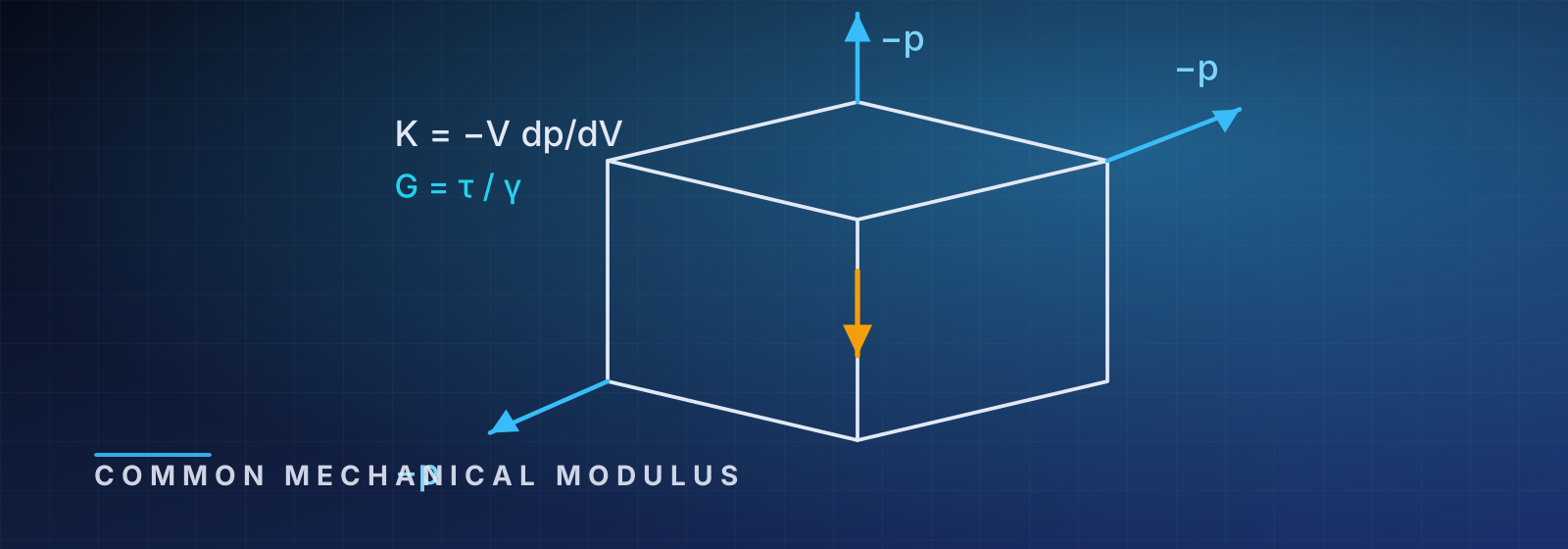
Bulk modulus, shear modulus, Young's modulus and Poisson's ratio are the handful of constants that connect stress and strain in linear elasticity. Use this page to define and convert between them when feeding material data into a simulation.
- Reading time
- 1 min
- Length
- 250 words
- Updated
- Sep 15, 2026
- Total views
- --
(1) Bulk Modulus
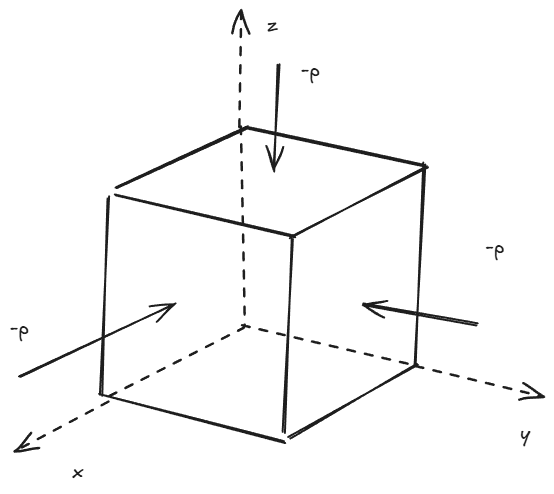
We assume that an Object is under some static hydraulic pressure
In homogenization expression :
For a
Here
From (1.2), We have
Since the
We note that the strain is uniform, we have :
then for the 2D case, the equation for bulk modulus is :
Where
(2) Shear Modulus
The shear modulus is defined as :
We have that for a shear force
note the stress components are :
And we have
For 2d case, it's :
For the 3d case, we only consider prescribed shear strain case, and it's the same as 2d form in one direction load. (for the prescribed shear stress case, it will use compliance matrix